09 August, 2023

Privacy Policy


Welcome to "Sustainable Growth". This Privacy Policy aims to inform you about our practices regarding the collection, use, and sharing of information you might provide through our blog.

Information We Collect

Automatic Information: Like many other websites, we automatically collect information through cookies, web logs, and other technologies. This information might include your IP address, browser type, language, access times, and referring website addresses.


Information You Provide: We collect personal information that you provide voluntarily, such as when you leave a comment or subscribe to our updates.

Use of the Information

We use the collected information to:Improve and personalize the user experience.
Respond to your comments or inquiries.
Send newsletters or updates if you've subscribed.
Analyze blog statistics.

Sharing of Information

We do not sell, rent, or share your personal information with third parties without your consent, except under specific circumstances, like complying with legal requirements or in case of merger, acquisition, or sale of blog assets.

Cookies and Other Technologies

We use cookies and other technologies to improve user experience and analyze how users engage with our blog. You can set your browser to reject cookies, but this might affect some functionalities of our site.

Links to Other Sites

Our blog may contain links to other websites beyond our control. We are not responsible for the privacy policies of other sites. We recommend you read the privacy policies of each site you visit.

Changes to this Privacy Policy


We may occasionally update our privacy policy. We will post any changes on this page, and if they are significant, we will provide a more prominent notice.

Contact

If you have questions about this privacy policy, please contact us at david.losadag (at) gmail dot com.

Last Updated: 2023/08/09

26 January, 2018

Start Menu does not work in Windows 10: Solution

Clicked but no menu appears (with the right button we get a hidden menu but not complete)
Oddly, the problem is from the display driver, the included one by Windows . Especially if we see the "Windows Shell experience host" tasks process consumes all the time 10% of the CPU or more.

29 April, 2017

Building a photovoltaic solar panel using transparent polycarbonate (Updated)


Update: Before you continue reading, please let me discourage you to use polycarbonate, (as I explain at the end of the post): You will be loosing money for the only reason that the cells and the polycarbonate doesn't have same expansion coefficient and lets the water go through it (very slowly), and all the efforts to avoid this disadvantages will fail miserably.


In this post we will see how to build a photoelectric panel DIY the most economical way, yet it is safe and durable (has to endure 25 years). As we shall see, the difficulty of manufacturing is very high, so I recommend it only for the handyman ;). In addition the process is long, but very satisfying if you like the "do it yourself" and are fascinated photovoltaic panels.
I have seen many examples in Internet short - lived home panels , some prepared with wooden frame , I doubt that last more than ten years, or in sealed with silicone tight box (so that moisture comes but then condenses inside unable to leave quickly, corroding cells), whereby the potential savings to the panel in a home goes for the short duration of efficiently it.
As discussed in the previous post , my intention was to use polycarbonate, three times it economical than glass, plus much safer and lightweight whose only problem is that dilates 3 times more than glass, and has a light output somewhat lower than the glass (and falling further to whiten with the sun), but stays within a reasonable range during the first 30 years, which is what interests us.

To fasten the solar cells, I have sought more easily and economically; unused support or back cover, but linking them directly to the polycarbonate, and thus kill several birds with one stone :
  • Reduces material costs,
  • Quicken the panel,
  • Avoid possible accumulation of moisture and / or water, as the polycarbonate is not totally impermeable (no plastic is, unless a barrier metal), so it is desirable that no gaps where moist air can accumulate.
  • It allows some light to pass between the cells, so that the bottom remains partially illuminated.
  • Cells give one the more "fresh" are higher performance; per ° C above 25, panel lose 0.5% efficiency. If we let the rear "air" only with a protective coating (paint, epoxy or silicone), will be best refrigerarán, last longer and give more electricity.

19 April, 2017

Maintenance of the DIY solar thermal collector

Getter and repaired
Hello dear readers, I do not know in your area, but here in northern Spain we have had a February 2017 very very windy, with gusts over 100 km / h  (some kind of cyclogenesis ), so strong that it removed literally one of the panels of cellular polycarbonate, and after the noise we heard, we have found, pushed by the wind literally against a tree!


So light it is (1 cm wide and 1 mm wall), who knows where we have found it if the tree was not in the middle of his path. Even it had a brown mark, a sign that before it arrived there, it hit the tiles of the house, partially breaking it.


But this would not have happened if the panels had been properly anchored, and better protected from the wind. On the one hand, the wood of extreme suffering the ravages of rain, rotting it, it should put more sheltered. And secondly, the screws that secured panels only the timber were fastened, when should having crossed and fastened to the rigid metal under it much safer.

10 March, 2017

Cleaning and drying a smartphone that has fallen into water: Eg. the NEXUS 5X


To repair wet electronic boards , like a mobile that has entered him water, as this Nexus 5X that, despite rapid action he took water by charging connector, speakers and hole cards, it is best use pure alcohol or distilled water and an ultrasound machine , in addition to rub with a soft brush on the visible parts (and still no full guarantees, as if you were running shorts could damage a chip).
If you do not want to complicate , and you have 30 or 50 € which typically charge for repairing these problems, better take it to a repair center phones with good professionals, you will leave no trace of water or debris and running (but do not light after the accident), or try the Waterrevive liquid (which works very well if turned off immediately).
But if the water has not reached penetrate into the metal lids of the base plate (where sensitive to interference electronics is hidden), we can obtain very good results without ultrasound machine with brush and distilled water or alcohol (alcohol It has the advantage that evaporates easily later).
Waterrevive : A couple of young Spaniards have developed a liquid that promises that your phone back up and running in 98% of cases, they say. This liquid (possibly alcohol, distilled water or other solvent of mineral salts) introduced displaces water (containing mineral salts) preventing depositing causing short circuiting. Using this system has good result if we turned off / disconnected the battery quickly, before the lime and salt is deposited. If that system will not work, you can try these indications (100% of cases so far) .

09 March, 2017

Adding hot bed BQ Hephestos 3D Printer: Compiling and installing new firmware

If we want to print in ABS, heated table need

There are instructions on how to do this on the official website of Spain BQ, but are outdated and only explain how to do it in version 1.4.2 , which differs substantially from the latest firmware more refined versions , such as 2.3.1 or 2.4.0 ( do not not try it with 2.4.0, it gives compilation error at the very beginning).

Well, in short, I will show how to compile the firmware to serve you for these and subsequent versions , with optional hot bed activated and working properly. But first, I show how I've ridden (and there tutos on youtube so I save this part - The guy in this video , although physical and clothing clavadito me, not me lol).
A clause ... is a company of the stature of BQ should have precompiled firmwares with different options , and let the user choose (even versions with height sensors for self - calibration table), it is outrageous that a user who does not have know anything about compilers, have to eat the head ... even though deep down that is when you ride a printer that whole piece yourself ... but it is a trifle compile and save many headaches (there are several threads forums questions about this topic).
Before anything else, apart from the table, cables and thermistor, to feed the table need a power supply of at least 12V 8A ( best of 11 or more); the more heat amps before the table and more easily keep you warm. The most economical and reliable is to use an old power source ATW at least 300W, by looking at the indicating amperes for connection + 12V, are durable and well refrigerated fan:

08 March, 2017

Repairing and updating a Lacie NAS (Fvdw version at Plugout.net)


If you have a Lacie NAS with a broken hard drive, it is very difficult to recover the Lacie firmware/partitions, but we can replace the HDD and install the Fvdw firmware version with this tutorial and improve its possibilities by the way.

Previously I explained several improvements with hard drives (NAS) I drive, Lacie brand with Linux firmware.
These small file servers have as main advantage that allows us to have servers of various types, in addition to files with very low power consumption (less than 10W in general).
The fact is that there is an alternative firmware developed improved from the LaCie sources that have compiled Plugout.net guys that we can install in our NAS, which greatly improved the performance of our network disks , adding possibilities as possible choose media server (ideal for home), NFS, VPN, etc servers and download torrent files, among others. And it also serves to revive the NAS if the hard disk fails, and see, step by step, the installation process.
  • Faster , it is having been optimized with the latest software versions, up to 40% more agile list of directories and copy files.
  • More reliable, uses file systems safer.
  • More complete , with all the features expected from a small server.

13 January, 2017

Improving the Ebike with Arduino to monitorize battery and add anti-theft alarm 2/2


As discussed in the previous post, my goals to put a microcontroller programmed with Arduino on electric bike they were:
  • With an RGB LED display the charge / status of the battery monitoring one of the (weaker if possible) cells, to avoid surprises of not having enough charge for the trip the next day, showing orange when needed recharging (between 20 and 40%).
  • With an accelerometer and a powerful piezoelectric speaker  (and a mosfet to activate) we can add an anti-theft alarm, easy disabled with a button hidden from view, which is very handy against foreign's friends.
  • And even (this slope time), add light automatic brake  using the accelerometer (which changes from low intensity to high intensity when the accelerometer receives a deceleration in the axis of the fly), to keep usage statistics (number of refills, airtime, or adding small OLED display to show instant consumption in Ah with  a Hall sensor  (such as Allegro ACS75x, etc), battery charging, etc.
So this Christmas I could get down to work, and start to test in a breadboard to get something functional:


12 January, 2017

Extending the range and power of the bike by adding two cells in the luggage carrier


Before this project, the battery of my bike consisted of 8 cells in series of 6 batteries LiFePo4 A123 in parallel each, and I realized that I could have some more top speed and range by adding two cells with the previously left over LiFePO4 A123 batteries, and changing the BMS for the one I found of 10S and 60A (much better than the previous 15Ah only):

BMS / Control LiFePo4 charging battery cells 10 and 60A  maximum.
I will not cease repeating that if ye ride yourselves a Lithium Ion battery, you must put always a BMS, as this is essential prottection for the battery, cutting the flow of current in both overload and over - discharge in any of the cells.
One important note: This only works if you use the SAME type and state of cells for the additional cells (or you will get an unballanced battery fast, or worse, damaged cells that can't cope with the current).

On the other hand, increasing only 6V maximum load, I can still use the configuration of the motor control for 24V (having automatic cut if they drop too low voltage with the BAC-281P ebike controller, we cut prematurely the current if we use 33V battery with a 36V configuration). 

Features of BMS 10S LifePo4 60A load balancing ref. BMS-10SQZ6060LF375 :


Important data:
  • 10 Cells LiFe 3.6V, 36V full.
  • Maximum peak current: 90A
  • Constant current approx. without sink: 30A
  • Standby power consumption: 0.1 mAh (100 microamperes / hour).
  • For the rolling is effective with only 70mAh per cell balancing, the load should be as slow as possible (depending on the difference of load cells), recommended < 500 mAh.
As  I noted, the 12 could fit on a damaged old hard drive enclosure aluminum made. 

17 December, 2016

Installation and improvements over an Hephestos Prusa i3 3D Printer from BQ


Those who follow me will have seen that I have uploaded some videos with the assembly of the i3 Prusa BQ, plus reducing vibration and the last has been adding LED light, adapting for printing flexible filament and isolating the extruder with silicone (spanish voice):


15 December, 2016

Improving cooling a powerful notebook graphics with a transistor and Arduino

Laptops that come with powerful graphics have an usually badly designed thermal control; This is the case of my dear Acer 5930G (already I spoke above ) wearing a removable Geforce graphics card.
Engineers Acer believed it was enough to regulate the fan with the processor temperature, since the sink joins both, but the graphics consume more, which can reach 70 easily while the CPU is 40 and the fan medium gas.
We'll see how we regulate the fan directly 5V , depending on the temperature of the area that interests us, with the advantage of being able to use any fan that can be coupled to our team, plus you can customize the level of cooling in the Arduino code. 

The result : I got him down more than 20 to the graph regarding the regulation of factory, from 70 to about 45 ° C at rest. And in 90 games at maximum 70 ° C. You hear more, because almost constantly is 100% , but if that win in durability, I welcome the resulting hiss. Another advantage is that by taking the power from the USB port, turn it off when no temperature peaks but still cooling off while connected to the grid, until it cools completely and stops. 

Materials Needed:
- Chip ATtiny85 
- Transistor NPN 50V typical and 5Vgs ( 2N4401 I used myself). 
- Capacitor 220uF 6V and min. 
- Diode 5V and minimum hold 200mAh. 
- Tubing.


13 December, 2016

Drivers for Windows 10 ATI RV370 (X300)


Here you have the direct download, without advertising, of drivers that work for this card in Windows 10 (64 - bit and I think also 32 bits).
If it gives you an error with the installation, you have to install them manually (by going to Device Manager -> Select Display driver (right mouse button) -> Update Driver, select it manually on the system, locate the driver directory).

I've gone crazy looking for them ... getting no more than incorrect drivers for it (Ati no longer supports it) so if I hope will save more than one headaches... :).

Reusing power sources to power devices of different voltages: voltage converters

42V DC Power 19V 2A regulated DC to charge a laptop that spends 3A
In this post we will see how to feed these appliances we have at home, whose power supplies had stopped working and left, forgotten, in a drawer.
For example, that portable power supply can have a second life and continue feeding any device that requires a power exceeding the capacity (watts) of the transformer. While we maintain the amps equal or exceeding the needings by the apparatus we want to power, we just have to make sure that the voltage output is the same or little less of your device needs.
If for example we need an  e-bike charger, or need a charger of a given voltage, we can adapt economically the output voltage: This is where the boosters and converters come into play modifying voltage DC to DC.

08 December, 2016

Improving the Ebike with Arduino to monitorize battery and other info 1/2


It is the second time it happens; I pick up the bike, and after the trip to work, the ebike left me without power in the middle of a slope... with the hassle of having to carry their 30 kgs. on a slopes over 14% (and the damage it does to the battery the depth discharge, fortunately are pretty well LiFePo that support this). 

I have no charging indicator (the handle that provided me is to 48V) to calculate if you have enough power for 4 km I have to do, and also the LiFePo4 have a very small voltage variation between 20% and 80% of capacity (between 3,15V and 3,35V), which is easily neglected. And make it load every day is not practical or the best for the battery (ideally recharge when you reach the 20% to maximize battery life). And the battery charge indicators seem to me too "greedy" energy. So...

A solution for every need ...


01/09/17: In the end I finished using a Nano and MPU-6050 accelerometer for burglar alarm functions and voltage indicator, in the 2/2 post from january 2017 you can see the details.

06 October, 2016

Types of Batterie Management Systems (BMS); building new batteries for our equipment


Complementing the already abundant information on this blog about batteries, recycling and repair, and BMS, I will analyze the types of BMS and qualities that we can find among Chinese BMS. The main reason for the short life of batteries any type is often their poor maintenance ; either because they remain flat or that are downloaded more than convenient (both lead as Li-ion do not tolerate discharges well below a certain level). To protect the batteries (particularly lithium dangerous if overloaded or short -circuited), the " battery Management Systems " or BMS come into play to good use and long battery life.

How to Choose the BMS we need

04 October, 2016

Solar thermal collector configuration supporting gas/oil boiler


Antonio from Orense had a solar panel with a deposit of 150 lts connected to the same circuit ACS but separately, so that when it was sunny had to walk opening and closing keys to harness this energy and save fuel in the oil boiler.
With solar thermal energy (pre - heat the water with a solar collector) all are advantages. This renewable energy system is today the fastest amortized, usually in two years the installation is amortized, and lasts up to 30 years , with minimal maintenance. It's easy money, and who have not it installed, properly sized, they are throwing money to the trash, literally.


After analyzing your installation of ACS (ignoring the heating pipes), I advised him to use solar thermal as we do; supporting boiler  (gas in our case).
The method is simple; it provides warm water tank directly to the boiler, so that it only has to provide sufficient energy to bring it to the temperature (usually 60 °), and so you forget.

02 October, 2016

DIY: Avoid overheating problems on your PS3 with a chip and sensor for 5 bucks


With a small chip Digispark ATtiny85 will see how to regulate the fan of the PS3 (or any PWM-controlled fan) depending on temperature, avoiding wear and tear prematurely. 
Engineers PS3 gave priority to the silence of the PS3 , since it is intended to be a center of games and multimedia, so the processors can reach damaging temperatures for the welds thereof, and within a few years ends up breaking down by poor contact welding (reparable only with reflow or reballing).
The PS3 has a pulse PWM controlled fan, Atmel ATtiny85 and can be easily programmed with the Arduino IDE.
There are examples on Youtube and internet people that has regulated the fan fixedlyto go ever faster (with a resistance in the gray wire connected to the 12V, regulating 1V approx., Or with a potentiometer to do it manually) but is not the best solution because it does not consider the processor temperature (which can vary greatly depending on ambient temperature), and although it works, having to cover all cases, there isusually noisier.  and with this solution we have the advantage that if we hear the very loud fan, you will surely have a problem of lack of ventilation dust or other problem.

materials

30 September, 2016

Centralized control Solar-Biomass mixed system with Arduino and TFT Shield


In this post I will share with you the improvements I've made to our biomass/Solar mixed system , which is basically to change the obsolete control system for thermostats with a centralized system based on Arduino fully customizable, flexible and expandable; we will see the assembly, components and source code.

Applied materials:

   1 - Arduino MEGA 2560 (specifically I used a Funduino clone ), because the TFT shield does not leave me enough inputs / outputs Free UNO R3.
   2 - Touch Screen TFT 2.4 "  McuFriend , which will give us great freedom when it comes to display information on screen libraries that have worked best for me. Are the BUHOSOFT ; here you can download the version I used.
   3 - relays to activate solenoid valves, with a fed to 5V that can handle 230V and 10A worth us to spare.Not to stress regulator Arduino board, the food independently with other L7805 regulator (handles between 7-30V and 1.5A max). Being so low consumption, nor need a heatsink:


   - A speaker-buzzer for alarm warning in case of problems, which operates between 7 and 12V 100dB, enough.
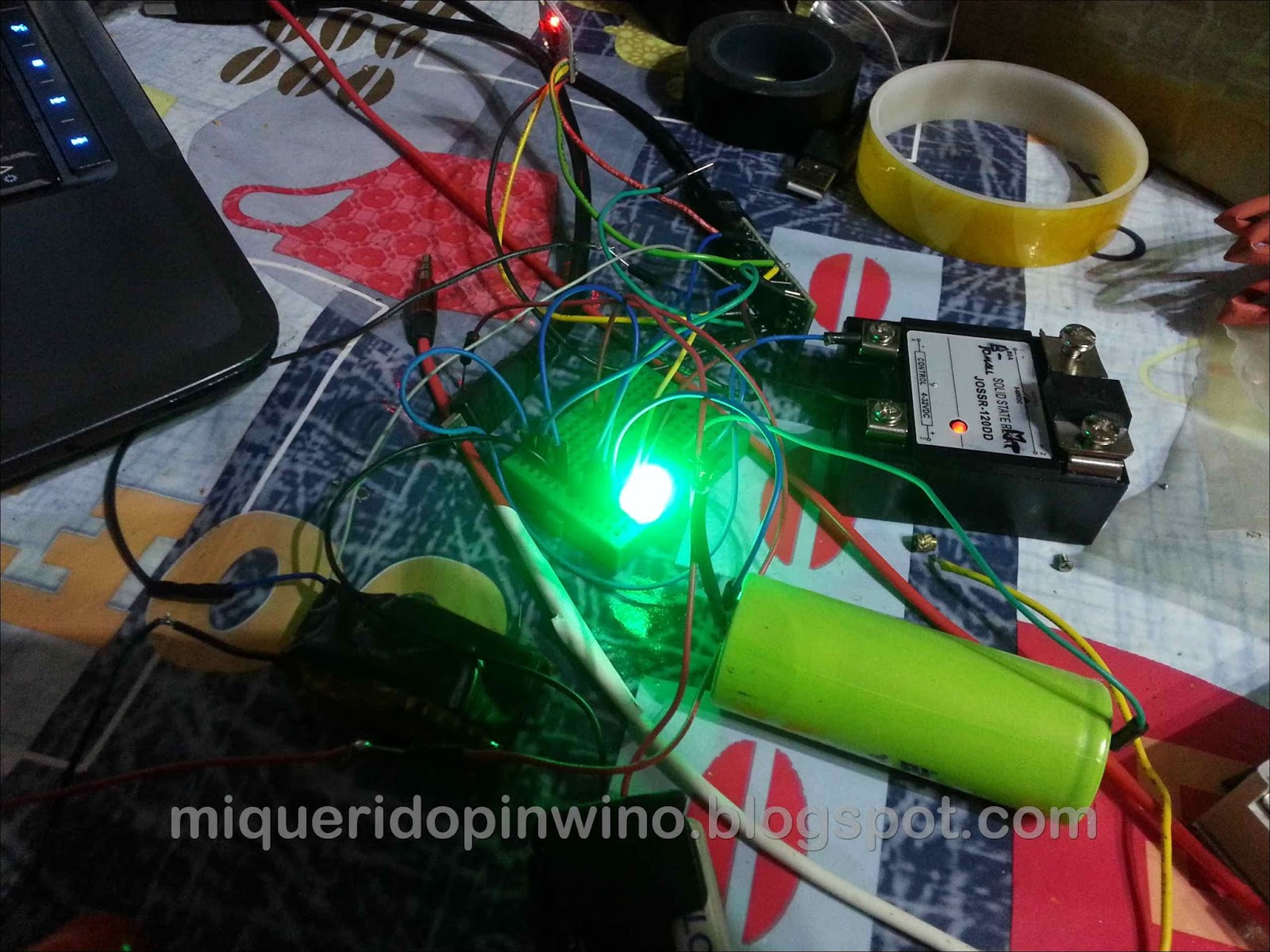
   - A relay SSR DC-DC to activate the buzzer ; only consumes between 3 and 25mA so we can turn directly to the Arduino pin. I used one of solid state more than anything because I had left the other, butsince it is an element that is to be activated soon, you better go to a mechanical more economical and compact:

22 August, 2016

Save energy with a timed plug: Do it yourself with Arduino

I used this to build a wireless plug socket countdown
I had a Wireless programmable plug Contros of Broadlink with the wifi card damaged:


and I realized that I could come in handy a plug to be activated for a certain time simply by pressing the button, with increments of the same time with each pulse (similar to working electronic microwave, that with each press of the button quick heated adds 30 seconds to the time). A picture is worth a thousand words (explained in spanish, sorry):

20 August, 2016

Modifying an insertable wood stove to add double combustion and fans

In this post, which had long been "waiting" for various reasons (my apologies to Alberto, intone the mea-culpa), an animated friend of sustainability we discuss how modified 2014 a stove without too much effort to optimize its performance , having fun how nice in the process.

Alberto tells us who dared to take pictures of it and write it done because it came in handy examples and information I put in this blog.
Adding steel tubes for double combustion and fans increase the combustion efficiency to deliver oxygen where it is needed, and also preheated, and fans are needed to optimize the extraction of heat to the room and extend the life of the stove by reducing the temperature of the structure , which otherwise would be very stressed by extreme temperature changes to increase performance. These modifications are safe (with the only danger plaster smoke, controllable and which will be discussed in detail). 
So, without further ado, let him be himself who tell us (apologies for the quality of the photos):

Presentation and project

The first is to introduce Alberto and I am not a professional in this sector, but I like the tools and I dare all.
I needed an insertable for the house in Ávila, at 1360m above the sea, as the chimmenie fire never could heat the cold granite house. And of course I wanted to double and double combustion chamber. 
I do not remember very well the extent of the gap in his fireplace; would be about 530mm, about, quite recently, I found an insertable fire made ​​of that size. The sides of the fireplace are also granite but the problem is securing a roof beam in the middle of the house and did not make me any grace the walls shake too.
So I Have This Test was willing to custom. I was asking for tempered glass in the door to start ... phew... 'find materials that work !!.
By chance I found a home at a low price approaching the measures, and for 250 euros I found very interesting in Leroy Merlin especially since half the work had already been done.